

Creators Are Boycotting ManyVids after A Controversial Statement From It's CEO

A wave of backlash rippled across the adult creator community after Bella French, founder and CEO of ManyVids, published a manifesto-style statement outlining her vision for the future of the adult industry. The statement, posted on her personal website, triggered widespread concern and prompted some creators to publicly distance themselves from the platform.
At the center of the controversy was a line that many creators found impossible to ignore: French stated that her long-term goal is “to transition one million people out of the adult industry and do everything we can to ensure no one new enters it,” adding that the industry “should not exist.”
For performers whose livelihoods depend on adult platforms, this was not read as abstract futurism. It was read as a rejection of their labor.
The Reaction
ManyVids has long positioned itself as a creator-first platform. Since its launch in 2014, it has marketed itself as a space where sex workers could operate independently, monetize their work in multiple ways, and retain more control than on traditional adult sites.
The platform supports a wide range of income streams: clip sales, custom content, fan subscriptions, phone sex, live camming, tips, and storefront sales. With reported payout rates ranging from 60% to 80% depending on activity and exclusivity, ManyVids became a core income source for many creators.
Its branding consistently emphasized sex positivity, inclusivity, women’s empowerment, and LGBTQ+ support. Against that backdrop, the CEO’s statement landed not as a personal opinion, but as a rupture between platform leadership and the people generating its revenue.
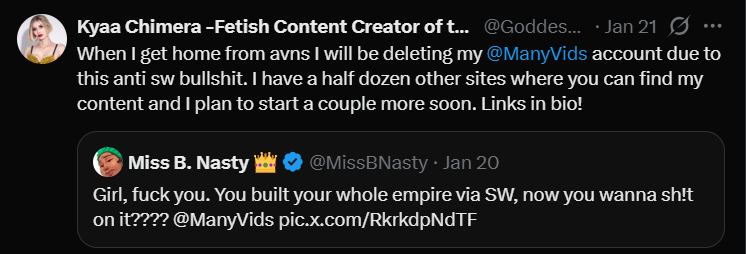
Creators took to X and other platforms, accusing the company of profiting from sex work while publicly framing it as something that should be eliminated. Some announced they were closing their accounts entirely.
The Statement
In her manifesto, French recounts entering the adult industry after a business collapse and experiencing content theft by unregulated platforms, experiences that ultimately led her to co-found ManyVids. She describes the company’s next phase as a fintech and social-impact hybrid, using AI-powered workflows to transition creators into what she calls a “diversified creative economy.”
What troubled many creators was not the idea of offering alternatives or tools beyond adult content, but the framing: a future where adult work itself is something to be exited, rather than respected as legitimate labor.
The Hypocrisy
As of now, no operational changes have been announced.
New creators can still register
Adult content categories remain unchanged
Payout structures are intact
The platform continues to actively market adult content
This disconnect between public rhetoric and present-day business operations is what many creators found troubling. If the industry “should not exist,” creators asked, why does the platform continue to rely on it?
French has not publicly responded to individual criticisms, and ManyVids has not issued a separate corporate statement addressing the backlash. The original manifesto remains live.
A Familiar Pattern
This moment highlights a long-standing tension in the adult industry: platforms seeking mainstream legitimacy while continuing to profit from labor stigmatized by the payment processes.

For many creators, the issue isn’t future innovation or optional exit pathways. It’s the present reality. Adult creators are building businesses, paying bills, and sustaining communities right now. When leadership language undermines that legitimacy, trust erodes quickly.
The backlash against ManyVids is not about resisting change. It’s about respect, transparency, and alignment. Creators don’t object to new tools or expanded opportunities. They object to being treated as a problem to be solved rather than professionals to be supported.
Why This Matter
This incident serves as a reminder of how fragile platform dependence can be. Policies, leadership perspectives, and corporate visions can shift overnight often without creator input.
For creators, the lesson isn’t panic. It’s strategy. Building platform-independent brand, diversifying income streams, and maintaining direct access to audiences are no longer optional. They are essential safeguards in an industry where narratives can change faster than terms of service.
Fear kills reach. Strategy builds longevity. And longevity, for creators, starts with owning more than just the content. It starts with owning the infrastructure around it.


